Timeline of world history & future development from Bible, Daniel 2 ……original version (3rd-Oct-2018), updated (Aug-2021)
Abstract
World history is reviewed by studying the Bible, Daniel of chapter two. It found that not only did it tell the sequence of rise and fall of kingdoms, but it also revealed the relevant timeline. By following the procedures of proposed method with reasonably simple physics and mathematics, the periods of kingdoms can be calculated and compared with world history. Then it attempts to predict the future timeline of the world. Finally, it will discuss the possibility of return of Christ in this generation based on the results obtained from the present analysis.
Objectives:
This paper attempts to look at the large statue in the dream of king Nebuchadnezzar (Daniel, 2) from a different angle. It aims to investigate the relevant timeline that may be revealed or hidden, in addition to the sequence of rise and fall of kingdoms. It firstly introduces the methodology for the calculation. The results obtained will be compared with the relevant historical era. Then it attempts to predict the future development of the world.
Background:
Before conducting the analysis, we shall have a brief review on the relevant section in the Bible, Daniel 2, 31-35 from Holy Bible {Ref. 1}. It describes the statue in the dream of Babylonian king, Nebuchadnezzar. It made of different metals including pure gold, silver, bronze, iron and clay as shown in Figure 1. Different parts of statue represented successive kingdoms in the world. The interpretation and the general understanding are as follow:
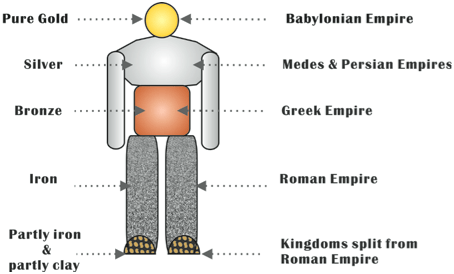
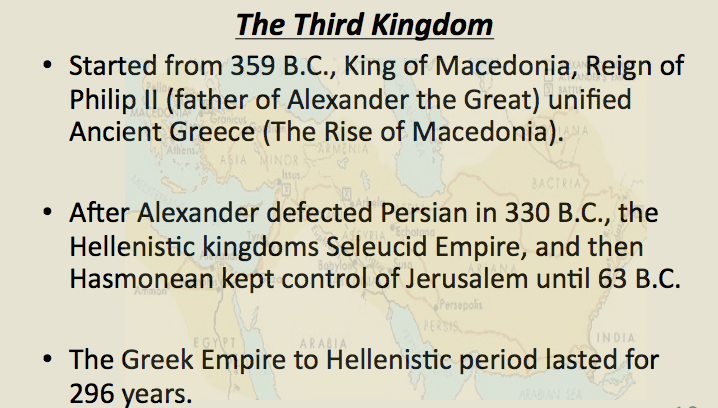
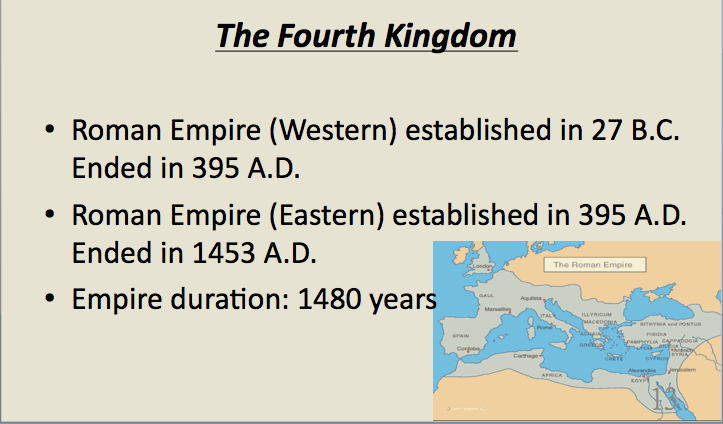
Babylonian Empire is the head of pure gold and then it was defeated by Medes and Persian Empires, i.e. the silver chest and arms. The third kingdom refers to Greek (Macedonian) Empire, belly and thighs of Bronze. The fourth kingdom, legs of iron, is Roman Empire. The feet partly of iron and partly of baked clay represent kingdoms of European countries split from Roman Empire. After that a rock was cut out (not by human hands) struck the statue on its feet and smash them to pieces. It became a huge mountain and fills the whole earth, i.e. the advent of Kingdom of God.
The definitions of head and chest are quite clear, while the other parts of the body may need some clarifications from the literatures.
Daniel 2:32
According to King James version, the 3rd kingdom is represented by belly and thighs. Belly, according to Cambridge dictionary, is the “front part” of the body between your chest and your legs. While thighs are the part of a person’s leg above the knee.
Two other authoritative versions are referenced, namely Septuaginta (LXX) from Ref. {2} and Masoretic Text (MT) which is based on the original Aramaic, i.e. the language believed to be used by Daniel for writing chapter 2, Ref. {3}.
For the “belly” part, all versions are consistent. For the 2nd part, the word used in the original MT version actually originated from the word “sides”. Therefore, it is more accurately referring to the sides of abdomen next to the belly, i.e. the “waists” rather than “thighs”.
Septuaginta (LXX) in ancient Greek:

King James version is shown on the left hand side below: “This image’s head was of fine Gold, his breast and his arms of silver, his belly and his thighs of brass; thighs: or, sides”, while Masoretic version is on the right hand side for comparison.



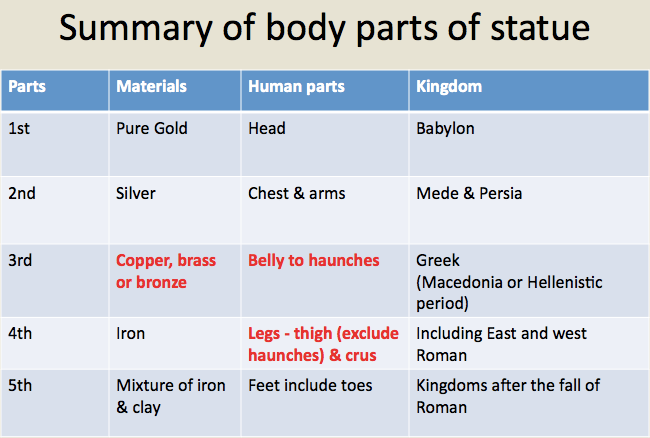
To summarise, the 3rd region should be more accurately referring to the region below the chest including the parts from belly, waist to the hips as shown in Figure 1 & 4. And the word “belly” will be used as a collective term referring to this region throughout the paper.
Daniel 2:33,
King James version
His legs of iron, his feet part of iron and part of clay.
Septuaginta (LXX)


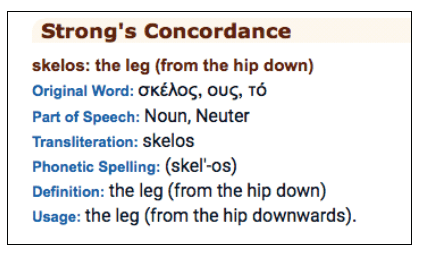
According to the Strong’s Concordance, 4628 (skelo), the definition of the leg is from hip down. When compare with the dictionary Ref. {6}, the “legs are the long parts of the body that are attached to your hips and have your feet at the end of them”, they have the similar meaning. It includes both crus (lower leg) and thighs but exclude haunches. Therefore, its length should be up to crotch from the ground.

Preliminary observations:
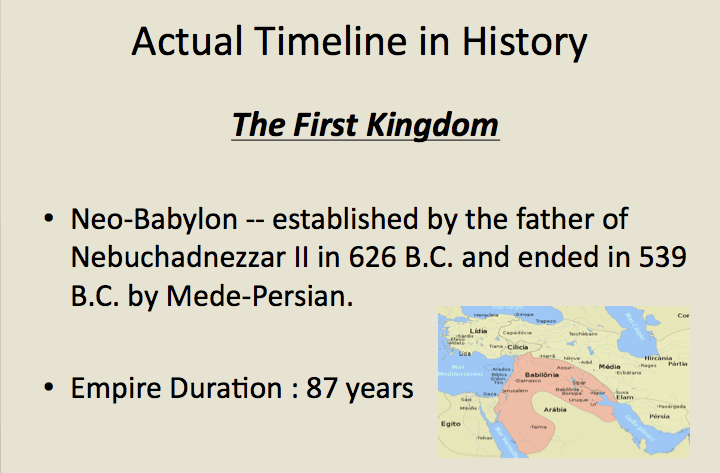
Figure 2 shows the timeline of the establishment and fall of the relevant kingdoms and their control of Jerusalem. Firstly, Babylon established in 626 B.C. then conquered by Medes and Persian Empires in 539 B.C. and it lasted for 87 years. Starting from top of the head (626 B.C.) to the legs, that is, the fall of Roman Empire in 1453 A.D., it sums up to 2079 years. They are summarized in Figure 2 below:
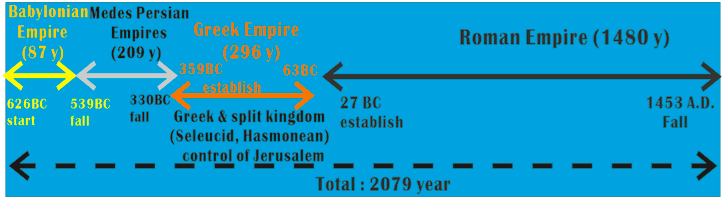
Figure 2 Timeline of the establishment and fall of kingdoms with their control of Jerusalem
Are the durations of the kingdoms proportional to the length of the human body parts?
If the duration of Babylon is compared with the length or the height of the statue:
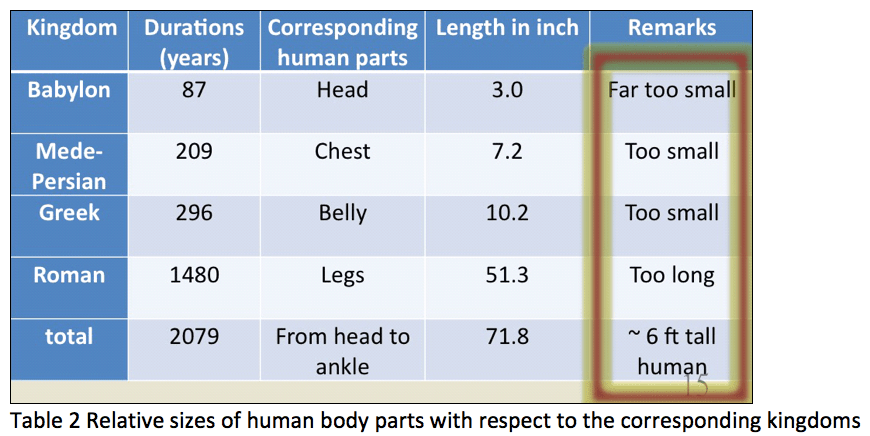
Head length: body Height = 87:2079 = 1: 24
It means that a man of 6 feet tall will have only 3 inch of head size, it is obviously not a proper human body ratio. Similar calculations for the other human body parts are tabulated below for comparison. The “Remarks” column of the table clearly shows that it is not quite convincing. However, we are now going to switch to another point of view to check if there is any new discovery.
Methodology
Actually it is inspired from Bible. After the 2nd chapter of Daniel described the dreams and the interpretations, the 3rd chapter recorded that Nebuchadnezzar made a statue of gold Aramaic 60 cubits high (27 meters, about 9 to 10 storey high building) and ordered his people to worship. No one knows whether the idea came from his dream or not, but it probably will generate the “enormous” effect looking from a man about just 2 meters tall.
Before introducing the method, the relevant physics of human vision has to be discussed first. In Ref. {7}, the length of an image, b formed by the eye is proportional to the visual angle, θ subtended at the eye by the object. The greater the visual angle, the greater is the apparent size of the object as shown in Figure 3. For example, although the size of the moon is comparable to the earth, it looks very small when we look at it on earth as the visual angle of moon is only about 0.5 deg.
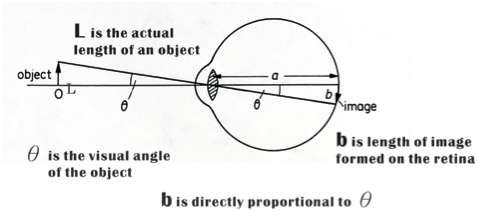
The calculations are just based on the two rules below:
- Number of years of kingdoms is directly proportional to the visual angle of the body part of statue;
- The scale of the head and other body parts of the statue is made according to human body
Human body parts ratio
Studies show that the head is about eighth of the height, H, i.e. 1/8 H. While other studies indicated that when the upper body measures 4 units, the lower body (legs) measures 3.5 units, therefore legs are about 3.5/(4+3.5) H= 0.467H. The remaining parts are equally divided for chest and belly, will be about 0.204H, for a reasonable estimation (Figure 4).
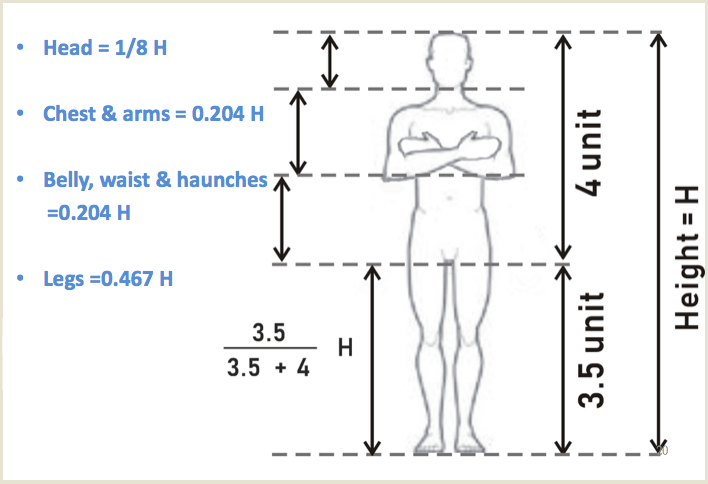
Accordingly, the length of different parts of 27m high statue can be calculated by inputting H=27 as shown in Table 3 below:

Roman Empire
Let’s try to imagine that there is an observer standing in front of the statue from a distance D. Let the angle A be the angle of elevation looking at the top of the head of statue and the angle R be the angle of elevation looking at the top of the leg (or at the point just below the haunches). Relevant equations can be obtained using trigonometry.
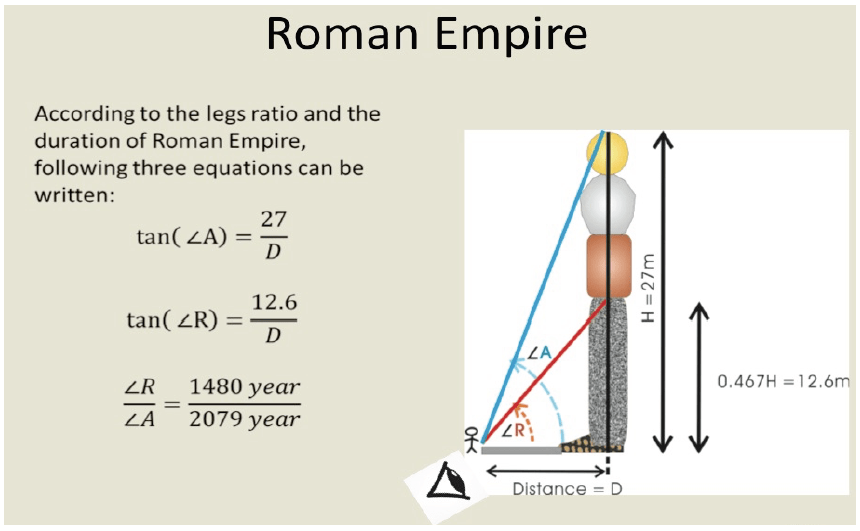
Applying the trigonometry as shown above, the following important parameters are found:
- Distance between the observer and image, D = 11.473 m
- Visual angle from the top of the head is 66.98 deg, representing 2079 year
Averagely, one degree angle is corresponding to
2079 year / 66.98 deg
= 31.04 year
The first kingdom: the period of Babylonian Empire
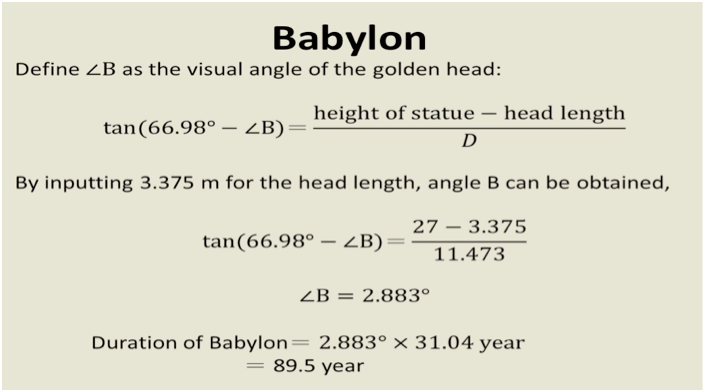
With these parameters, calculation of duration, in terms of year, can be conducted for each empire. Firstly for Babylon, define Angle B as the visual angle of the golden head:

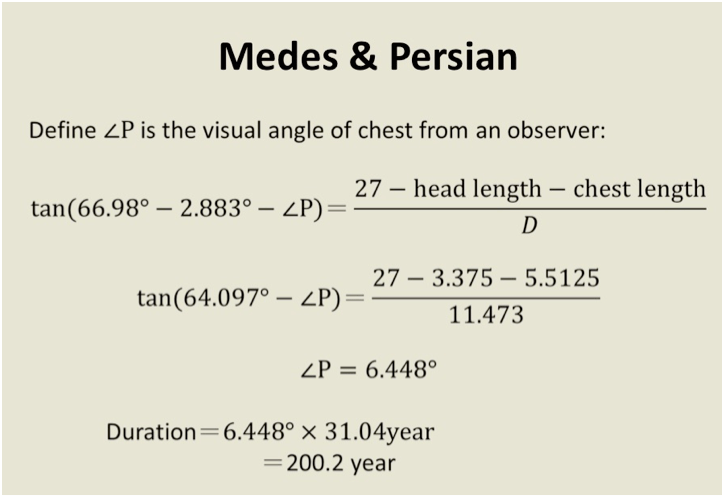
The second kingdom: the period of Medes & Persian Empires
This period started from conquering the Babylon, the estimated length of the chest from Table 3 is 5.5125 m; the following equations can be obtained:
Define Angle P is the visual angle of silver chest from an observer:

The third kingdom: the period of Greek Empire (Macedonian)
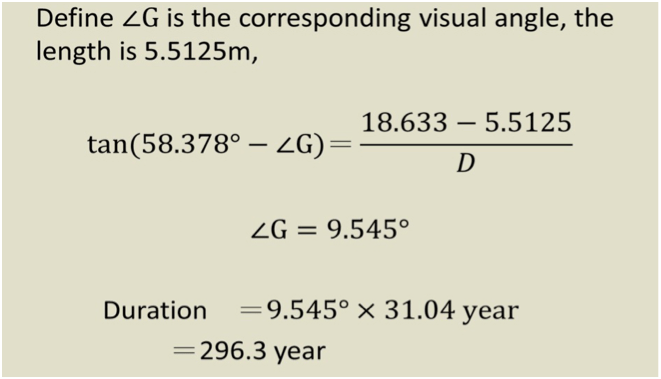
This period started from its establishment in 359 B.C. as shown in Figure 2. Therefore, the corresponding angle of elevation and the height of the beginning of this period can be found as below:

Similarly, the corresponding visual Angle G of copper belly and hence the duration of this period of Greek can be found as below:
Results of analysis:
The results obtained from previous section are listed below in Table 4.
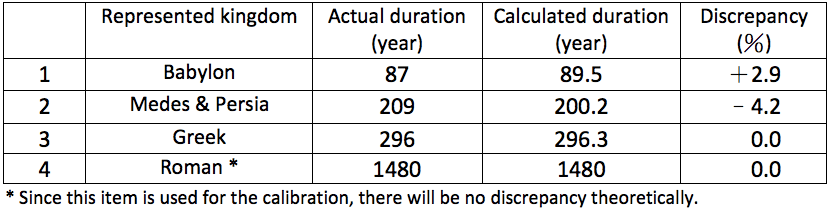
The results showed that the first and second kingdoms have only +2.9% and -4.2% of discrepancy when compared with history while the third kingdom almost agreed with the actual duration. Therefore, we can draw the conclusion that the following hypothesis is tested and supported by historical timeline of four kingdoms within the range of ± few percent of discrepancy, say around 3 to 4 %:
Duration of the kingdom is directly proportional to the visual angle (apparent size) of the corresponding human body part of statue, looking from an observer on the ground
Since these results provide solid support for this analysis. Therefore, it will be extended to the era beyond the Roman Empire in the next section.
Calculation beyond the Roman Empire
According to the sequential order of the statue, now it is time for the calculation of the “feet” after the legs. It can be handled as below:
- Scaled down 27 meter statue to 6 feet tall (or 72 inch about the height of a man)
- Compute how many years are represented by one inch on the ground to a 6 feet tall man
Ankle is the closest part of leg to the ground and connected to feet, therefore its parameter could be applied to the feet. An inch height at the ankle of a man of six-feet-tall is proportional to 0.375m of 27m high statue since 27 meter divided by 72 inch is equal to 0.375 meter per inch.
The corresponding visual angle, Z, from an observer standing at D=11.473 meter away, can be found by:
0.375/ 11.473 = tan (Z)
Angle Z = 1.872 degree
Since 1 degree = 31.04 year, therefore apparent size of angle Z corresponds to 1.872 X 31.04, i.e. 58.1 year. We assume the vertical time scale at the ankle is same as the horizontal time scale of the foot, therefore an inch on the ground corresponding to 58.1 year.
Time Scale of one inch on the ground for a six-feet-tall man = 58.1 years
The duration of “foot and toe eras” can be calculated using this time scale. In order to do this, average length of feet of human must be found. Recent research, Ref. {8} from a researcher in 2018, in Iran (the native land of Persia and neighbor of ancient Babylon) conducted the measurements of the length of feet. The results are summarised and shown in Table 5.


When it is converted to inch, the mean length is about 10 inch* from Ref. {8,9}. Another research shows that average length of toes is about seventh of foot, i.e. about 1.5 inches. It should be noted that nearest ½ inch is good enough for a reasonable estimation.
Average length of foot (excluding toes) = 8.5 inch
Average length of toes =1.5 inch
Their corresponding durations would be multiply by 58.1 year:
Duration of Foot era (excluding toes) = 8.5 X 58.1 = 493.9 year
Duration of Toes era (average length of five toes) = 87.1 year
A study from a 2014 report by American Academy of Orthopaedic Surgeons also shows that average shoe size for a man is between 9 and 12, i.e. the average lower limit is about 10.3 inch that is within ½ inch of present proposed accuracy. The chosen average of 10 inch is reasonable size for human foot.
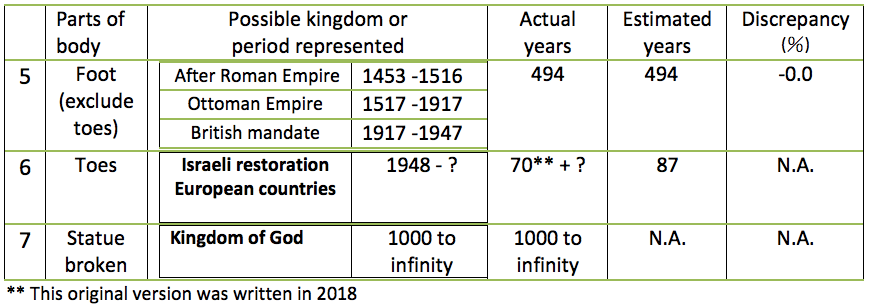
The results are rounded off to nearest year and summarized in Table 6:
Discussion:
In Table 6, it includes the items of Ottoman Empire and British mandate; it is because of their control of Israel native land and Jerusalem. When we compare the period of “the British mandate from the fall of Roman Empire” with the calculated years of the foot (excluding the toes), they are almost the same, i.e. 494 years. If this assumption is correct, we are now probably in the “Toes Age”. If this age is 87 year, there are 17 years to come from 2018. The advent of Kingdom of God may probably be in around 2035 with to 1 to 2 decades of error as proposed ½ inch of accuracy in previous section.
As the feet and toes are described as divided kingdoms with partly of iron, it will have some strength of iron in it, i.e. the strength of breaking and smashing everything (Daniel 2:40-41). The most possible representatives are Britain, Spain, Portugal and France, their empires developed globally between 15th and 20th centuries. Due to the advances of navigation technology and military forces, they established a lot of colonies worldwide in the “foot” period. The outstanding one is the British Empire; it conquered almost 1/4 of world during its golden age. It exhibited the strength of iron to the limit. In the middle of 20th century, it reached the commencement of “Toes age”. As the nation’s power consumed during the participation in the 2nd world war in 1940s, it started to decline. When their colonies began to get independence, the nature of partly strong and partly brittle became more and more distinct. Nowadays, countries including Britain, Germany and France are comparably stronger while some countries were suffered from financial crisis. It does show some contrast in their national strength.
Conclusions
The present proposed hypothesis is tested and found to be well supported by historical timeline of four kingdoms within the range of ± few percent of discrepancy, say around 3 to 4 %:
Duration of the kingdom is directly proportional to the visual angle (apparent size) of the corresponding human body part of statue, looking from an observer on the ground
When the vertical time scale at the ankle of statue applied to the foot on the ground horizontally, the advent of Kingdom of God is estimated to be 2035.
To conclude,
1. Present analysis shows that when the God gave the dream to Nebuchadnezzar, the relevant timeline of the kingdoms is already inherent in the human body statue.
2. Durations of kingdoms were found to be directly proportional to the apparent size (visual angles) of the human body parts of statue from an observer on the ground.
3. The results of analysis supported the possibility of His return even in this generation.
Some studies showed that the return of Christ mentioned several hundreds times in New Testament, therefore it is considered as one of the most important message from God. It should be noted that the rapture of church could be happened much earlier according to pre-tribulation theory of some bible scholars. Please be advised from the following verses from Bible,
1, Exodus 34:6, The Lord, the compassionate and gracious God, slow to anger and abounding in loyal love and faithfulness.
2, Isaiah 55:6, Seek the Lord while he makes himself available; call to him while he is nearby.
3, John 3:16, For this is the way God loved the world: He gave his one and only Son (Jesus Christ), so that everyone who believes in him will not perish but have eternal life.
However, we should not plan our financial arrangement according to the proposed deadline of 2035, as the accuracy of this prediction is about decade(s) and also subject to the average of ≈ 8 billions of human feet size. If you have already accepted Jesus as your saviour, congratulation! Please keep the faith until we see Jesus Christ face to face while still alive. If you still hesitate, you can pray and ask Jesus to help you to make a right decision. Even if you are non-believer, you still have a chance to believe Him after the rapture of church, yet you may experience very harsh situation. However, the ultimate deadline should be around the second coming of Jesus.
References:
{1} Holy Bible, Chinese/ English, Union New International Version. (1995)
{2} Bible, Septuaginta (LXX), academic-bible.com, electronic version (visited in 2018).
{3} Biblical Tools, https://bible.fhl.net/index.html
{4} A Greek-English lexicon, by Liddell, Henry George, 1811-1898; Scott, Robert, 1811-1887, https://archive.org/details/greekenglishlex00lidduoft
{5} Biblehub.com, Strong’s Concordance, Greek, https://biblehub.com/greek/4628.htm
{6} Sinclair, John Collins Cobuild English language dictionary. London, Harper Collins. First publication (1987)
{7} Nelkon & Parker Advanced level Physics, 5th edition. (1982)
{8} Hajaghazadeh M, Emamgholizadeh Minaei R, Allahyari T, Khalkhali H., Anthropometric Dimensions of Foot in Northwestern Iran and Comparison with Other Populations, Journal of Health Scope. (2018)
{9} A report by American Academy of Orthopaedic Surgeons (2014)
copyright (c) 2018-2021 by Christian H. CHAN
Make a one-time donation
Make a monthly donation
Make a yearly donation
Choose an amount
Or enter a custom amount
Your contribution is highly appreciated.
Your contribution is appreciated.
Your contribution is appreciated.
DonateDonate monthlyDonate yearly Prediction of the second coming of Jesus